The world probably has as many children today as it will have in future according to the latest UN population report. I have been studying the global trends and the examples of Japan and South Korea in particular as they lead the way with aging populations and even move into depopulation.
Australia is predicted to have less population growth and an aging population. That means a higher proportion of the population being aged and the aged living longer. So the population will continue to grow but mainly from immigration and the current people living longer, rather than from more babies or school-aged children.
Looking at the projections for 6-year-olds in Australia, we can expect fewer school starters than now in 2028-2032 with possible increase after that if fertility rates increase and Australia achieves immigration targets in a world with more countries competing for immigrants.
 1Table: Australian Government Population Projections data downloads
There are currently 5,310 primary (either stand-alone or combined with secondary) schools in Australia. If the extra 20,700 6-year-olds projected by 2034-35 eventuate and were spread across all of them, each school would need to add an additional 3.89 places in 10 years.
Recent calendar year data shows the total fertility rate fell in Australia to a record low of 1.50 in 2023 in line with global trends (figure below for AUS). The above table assumes it will pick up again to 1.62 by 2031-32.
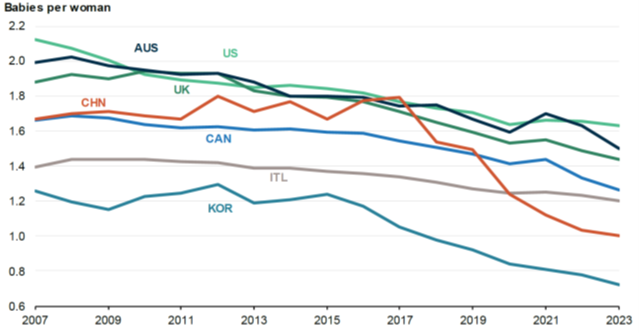
1Figure: Total Fertility Rates, Selected Countries
This makes planning schools interesting when the population might appear booming at the moment but the 20-year school-age projection may see decline. How best to balance short- and long-term planning?
Past trends predict the future until they don’t. Past assumptions that there will be more children in the future cannot be assumed any longer.
We have the advantage of being a 185-year-old education system within an over 500-year global Lutheran schooling movement. We have adapted to the move from Prussia to Australia, wars, closures and openings. With the help of God and in His service, Lutheran education will, as it always has, confidently adjust to the population around us.
Sources:
If you are interested in reading more about this topic, these are some of the resources that informed this message:
https://population.un.org/wpp/publications UN World Population Prospects 2024
1https://population.gov.au/publications/statements/2024-population-statement Australian Government Centre for Population | 2024 Population Statement
https://www.abs.gov.au/statistics/people/education/schools/latest-release ABS Data on government and non-government students, staff and schools
https://www.thelancet.com/journals/lancet/article/PIIS0140-6736(24)00550-6/fulltext Global fertility in 204 countries and territories, 1950–2021, with forecasts to 2100: a comprehensive demographic analysis for the Global Burden of Disease Study 2021 | The Lancet
https://youtu.be/nmdujC0MUKA?si=krG_uQUfvnou5JBX Japan’s population crisis reaches tipping point | Financial Times
https://youtu.be/zItgxM1sNqw?si=ZUQVD14Gw_GnCqhy Why fertility and birth rates are falling – The Global Story podcast | BBC World Service
Lisa Schmidt, LEA Executive Director